
Making the RV Decision
Our decision making process to get into an RV

In my previous post about what led us in the RV world, we covered a typical family that grew up enjoying the outdoors and camping whenever we could. This continued into our adult lives where we took our family out camping and created some of the best memories of our lives. Then life happened and we found our camping gear collecting dust while we tended to work and teenager activities. With the bulk of these self-imposed restraints fizzling away as our careers have progressed and kids go off to college, we found ourselves living in an area ripe for outdoor adventure and the call to the great outdoors echoing loud enough that we decided RV’ing is next on our horizon.
So, in this note I hope to walk you through the criteria and decision steps we took to get into the RV we have today. Committing to an RV is not to be taken lightly. If you’re Mr. Monopoly and money is no object you can ignore what I have to say and get one of each type of camper – just in case. But if you are mere mortals like us and operate on a limited budget, you need to make sure the RV you get meetings as many of your needs as possible for the most affordable cost. To do this, we tried to focus on three main categories to consider: Purpose of use, Ease of function, and Budget.
Purpose of Use
For this category, we didn’t employ any complicated algorithm or develop some sophisticated matrix to compare and contrast the universe of potential camping conditions or environmental constraints. No, we simply sat down and asked ourselves, what do we see ourselves doing in an RV. Some questions that came up are:
Do we want to go on long trips and be living in it for week or months, or would we more than likely see ourselves using it for a few days at a time (i.e., weekend warrior stuff, a few days in wine country, etc.)?
Do we plan to stay on the gloriousness of the paved road, or do we plan to hit the dirt and venture to the back country?
Are we going to be fair weather campers, or do we want the flexibility to camp in all four seasons?
Are we going to be expecting travel buddies (i.e. dogs or kids) that we need to accommodate, or will it be just the two of us and others can fend for themselves?
Are the luxury items of large spaces and full sized everything a must, or can we go minimalist and survive off basic accommodations?
How many toys (i.e. bikes, kayaks, SUPs, etc.) do we need to make room for?
Is this something we see being an RV that is strictly for camping or can be used for other purposes (i.e. moving large items or serving as a ski resort parking lot tailgater)?
Other questions came up along this thought track, but we really focused on the above ones as that dialed us into what we were looking to solve in the type of RV we wanted. With some of these questions out on the table, we shifted to the other category of consideration – Ease of Function
Ease of Function
This is a category we sort of stumbled on during the discussions we’ve had with others that brought to light aspects of RV’ing we knew where there but didn’t really compartmentalize. I’m not sure why that was as many of the questions that came up seem self-evident, but until you truly focus attention on them do you see how impactful they are to the decision process. The questions we asked were:
Would we be ok with a motorized RV and all the requirements that come along with that (i.e. vehicle registration, insurance, maintenance, etc.), or do we want to use an existing vehicle (possibly even getting a rig to pull the rig) and avoid that hassle?
Do we have the skills, or more importantly the patience, to be dealing with a trailer?
Are we leaning toward an RV that is pull-in ready with minimal set up or can we stomach a few more steps to get our campsite in order?
As for use, do we see ourselves boondocking (camping in non-designated campsites without access to water and sewer hook-ups) or should we plan for the convenience of designed campsites?
Are we looking for an RV that we can store in our driveway or somewhere nearby, or are we ok with the additional responsibility of an RV storage lot?
Are aftermarket addon’s for your RV necessary or would you be ok with stock features and just focusing on functional items to make the rig your own?
As these questions came up, we really started to think more about the operations and the practicality of what we needed. Not everyone likes pulling a trailer, nor does everyone like having a separate vehicle to maintain. Compound that with other factors like ease of setting it up and where to store it when not in use, these things we knew we needed to answer before we committed to anything. Lastly, we had to come to the realization that we are not gazillionaires and needed to define the last category – Budget
Budget
This will definitely be a category that varies greatly from family to family, and it will definitely define what size, shape, and type of RV you get into. For us though, we needed to break this down into two types of budget:
Cost to Buy: This would be the price you pay for the RV, tag/title, and registration. This is typically the big number that drives you to one RV or the other.
Cost to Operate: This is the cost of ongoing maintenance and storage. It may be often overlooked in the buying process, but one needs to consider these costs or else you’ll find yourself in a perceived “money pit” situation if you don’t plan correctly.
Some other things in this category may impact the above costs that one should consider as they may help offset these costs:
Is buying the priority or are you ok to lease or rent?
Do you plan to do this alone or are you thinking about getting with other family or friends to spread the costs
Is putting your RV into a rental program in the realm of the possible?
There are definitely other things to consider, so ask around and do your own research to see other options that are available to you. These are the main ones we hit on and helped us navigate through the mine field of dos and don’ts.
Now with the three categories of consideration on the table, we really asked around on how best to prioritize them. Frankly, if we asked 10 people their thoughts, we’d get 15 responses. All input was welcome, and we appreciated how others approached the same decision-making process as we did. Leveraging decisions we’ve made in the past on other major purchases like cars and houses, we landed on:
Priority #1: Clearly define what you need for Purpose of Use and Ease of Function first
Priority #2: Then figure out how to pay for it.
Based on our experience if you strictly let your budget drive the other two, you’ll find yourself in a rig that you will struggle to love and may just wind-up resenting. There are a wide range of RVs with almost an unlimited set of options that would fit just about any budget, so only compromise where you have to. If you find yourself compromising more that what you want out of an RV to get into your price range, I recommend holding off till what you want becomes affordable. Or resign yourself to the fact that you’ll have to budget more in the future to modify/upgrade your rig to get it to where you want it.
That leads us to what we decided was our own purpose of use and ease of function. So we decided on the following criteria:
We wanted an RV that was mostly going to be weekend warrior friendly with an occasional longer trip.
We didn’t want to be limited to pavement, so it would need to be off road capable with either 4X4 or AWD.
Wanted an RV that can take hot and rainy summers while also talking on the snow and freezing temps of the winter
It was only going to be the two of us, so we didn’t need much. Additionally, we wanted the minimalist approach so no need for a Barcalounger or a dish washer.
Something that just needs to carry bikes and kayaks and not much else.
We didn’t want to mess around with trailers, so it needed to be motorized.
It would be nice to pull into a site and be set up within minutes and minimal screwing around.
The RV needed to be self-contained as we would like to camp off grid to really take in the adventure.
Storing in our driveway, even for a few days, needed to be an option.
We know we will want to update over time, so we wanted a vehicle that has a lot of after market options we can build on as we go.
Now that we locked that down, we determined our budget that we could afford and spent the better part of a couple years researching all kinds of RVs. We quickly narrowed it down to a camper van as that offered the ease of function we need yet still meeting the purpose we’re looking for. The 4X4 need alone with self-containment for power and water narrowed it down even further. After those considerations, we honed in on two van both on the Mercedes Benz Sprinter platform: Winnebago Revel and the Storyteller Overlander. Both provided us most of what we were looking for in an RV and both are very capable, 4X4 equipped, all season, and very user friendly van that would be a joy to own. They both have a whole community of users willing to share thoughts and ideas with, so the decision between the two came down to a few minor things – a shower inside and a bed you didn’t have to break down. So, drum roll please, we went with the Revel. Here she is on the lot the day of purchase.
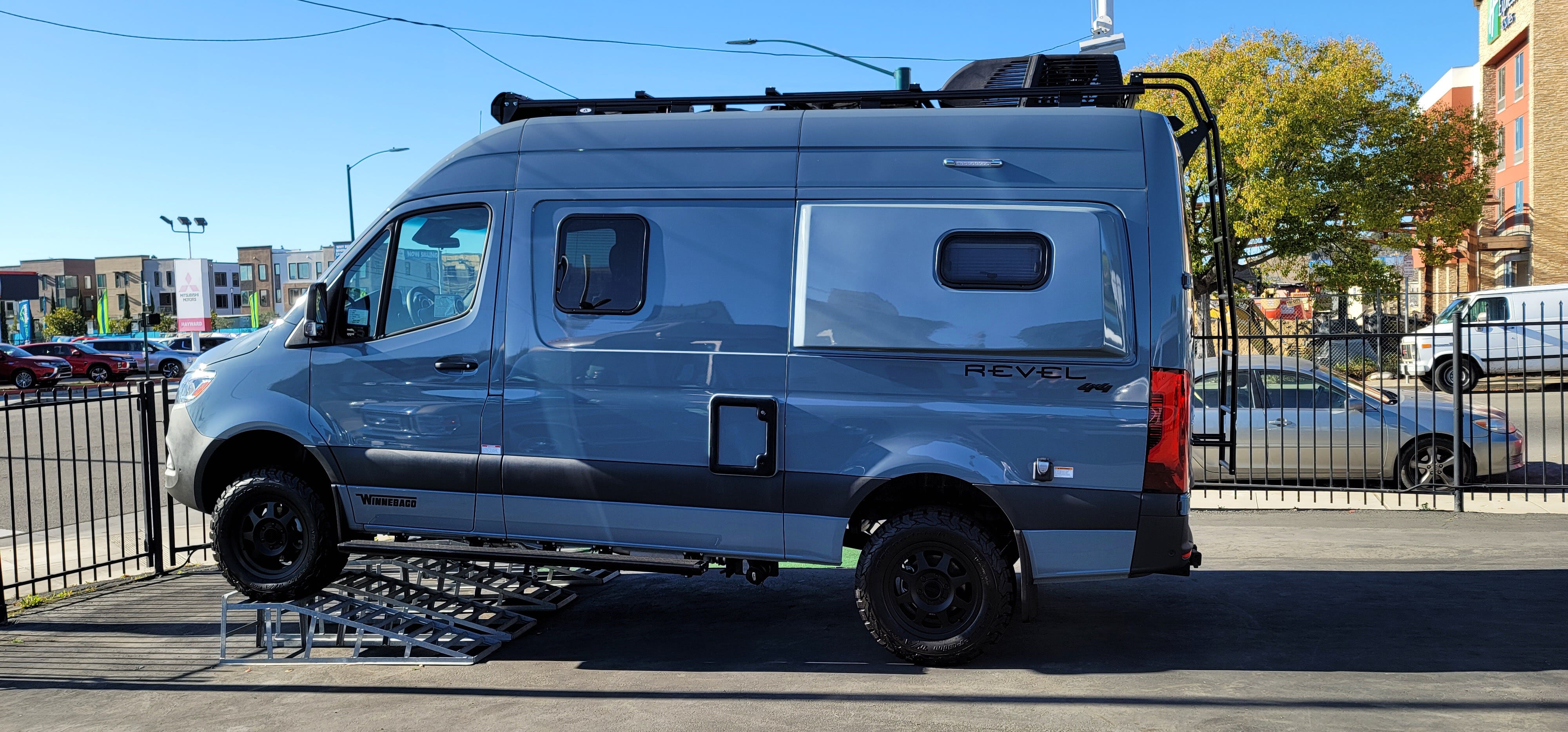
In future articles, I’ll go over some of the modifications I’ve done to her to make her more of our own yet still enhance the functionality and capability of the rig. I’ll also share some smaller snig bits on lessons I’ve learned along the way that may help others as they experience similar adventures.